
Robots, so hot right now.
(s/o to my Zoolander fans)
Or I guess they’ve always been hot? From “Danger, Will Robinson” to “I’ll be back”, our society has a fantastical way of viewing robots. Over the past decade plus of being in the spine industry, I feel privileged to have been able to see the beginning of robotics shift from joints to spine. I have heard the spectrum of feedback about how helpful (or not) robotics is when it comes to surgery. Recently, I heard another company released their “spine robot” with technology you’re probably familiar with in TKA, but I, am not. So, I wanted to investigate it, and what the implications could mean for spine.
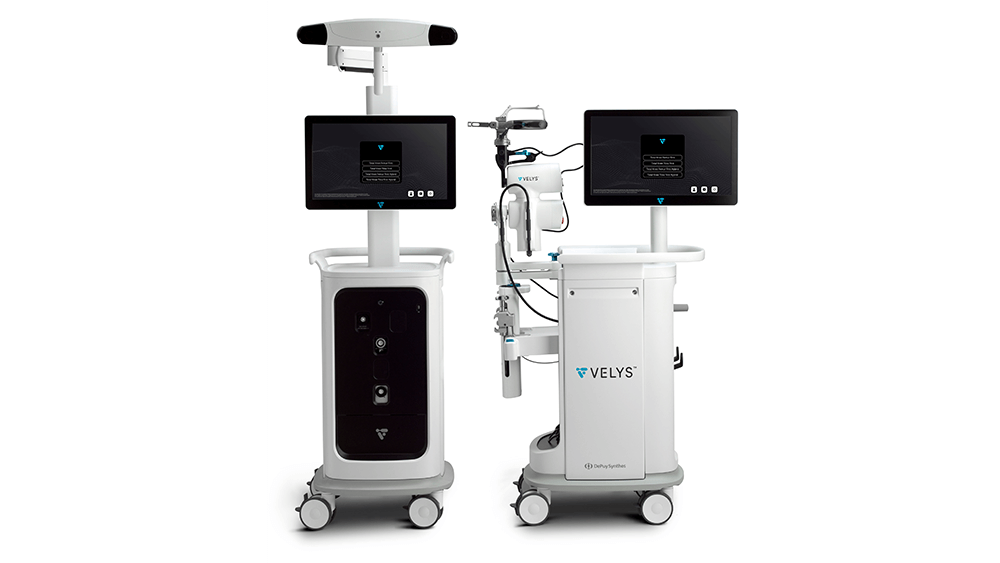
On August 2nd, DePuy/J&J announced on their media site that their first active spine robotics and navigation platform had launched. Developed by DePuy Synthes with eCential Robotics, the platform is FDA cleared for cervical, thoracolumbar, and sacroiliac spine procedures. It offers “tailored surgical guidance” based on surgeon preference, such as pathology-specific workflows, and includes VELYS™ ADAPTIVE TRACKING TECHNOLOGY (“High-speed camera, triple-drive motion technology, and PURESIGHT™ Hydrophobic Optical Reflectors work together to adjust and control the resection plane for accurate, consistent execution to plan”[2]) and VELYS™ Trajectory Assistance. Commercial launch is expected in the first half of 2025.[1] Assuming that after seeing increased sales in knee and hip, expanding robotics into other orthopedics uses, like spine, makes sense. Velys was also received clearance for PKA.[3]
There was a mention of “active robotic system” during my research and based on an article in the Journal of Orthopedics, “An active robotic system (ARoS) for TKA automatically executes planned bone cuts without human guidance of the cutting tool during bone preparation. Active robotics for TKA has been available since 2000 with the introduction of the ROBODOC®, which has been used in more than 8000 interventions.” The results of this paper, a multicenter study, showed no patients experienced pre-defined complications, revisions, reoperations, or bleeding and minor complications (joint stiffness, retained tack) had minimal impact on patient outcomes. Surgical times were shown to decreased with experience, there was significantly lower malalignment rate compared to manual TKA (11.2% vs 32%), and it produced accurate implant placement within 1.5mm or 1.5° of planned position.[4]
The biggest implication I found for this robot was the utilization for minimally invasive surgery. There are navigation systems existing that assist with proper placement of items such as pedicle screws, but knowing there is more carpentry when it comes to procedures like discectomy and fusion, I think the greater the precision the robot can prove in cutting, the more use it will have in spine surgery as more procedures move to an MIS variation.
References
[1] DePuy Synthes Launches its First Active Spine Robotics and Navigation Platform. Johnson&Johnson Media Center. (2024, August 2) https://www.jnj.com/media-center/press-releases/depuy-synthes-launches-its-first-active-spine-robotics-and-navigation-platform
[2] VELYS™ Robotic-Assisted Solution. https://www.jnjmedtech.com/en-NZ/velys/knee/product/robotic-assisted-solution#:~:text=ADAPTIVE%20TRACKING%E2%84%A2%20Technology,accurate%2C%20consistent%20execution%20to%20plan.
[3] Taylor, N.P. (2024, August 5). J&J launches Velys Spine surgical robotics andnavigation platform. MedTech Dive. https://www.medtechdive.com/news/jnj-launches-velys-spine-surgical-robot/723253/
[4] Stulberg, B.N., Zadzilka, J. D., Kreuzer, S., Kissin, Y. D., Liebelt, R., Long, W. J., & Campanelli, V. (2021). Safe and effective use of active robotics for TKA: Early results of a multicenter study. Journal of Orthopaedics, 26, 119–125. https://doi.org/10.1016/j.jor.2021.07.001
IMAGE — https://www.jnjmedtech.com/en-EMEA/products/velys-robotic-assisted-solution
 The Brit Factor
Leave a comment