
TL;DR
- Surgical planning centers on discs, nerves, and alignment.
- Multifidus muscle quality is visible on MRI but usually ignored.
- Fatty infiltration predicts worse pain relief, more mechanical failure, and higher revision rates.
- In at least one cohort, muscle degeneration predicted adjacent segment disease better than discs or alignment.
- Overlooking muscle quality helps explain why some technically sound surgeries fail clinically.
Watching how lumbar spine surgery candidates are usually evaluated, the focus is almost always the same. Surgeons concentrate on disc degeneration, nerve compression, and alignment. These are the findings that dominate case conferences, operative planning, and postoperative explanations. What receives far less attention, despite being visible on nearly every preoperative MRI, is the condition of the paraspinal muscles, particularly the multifidus.
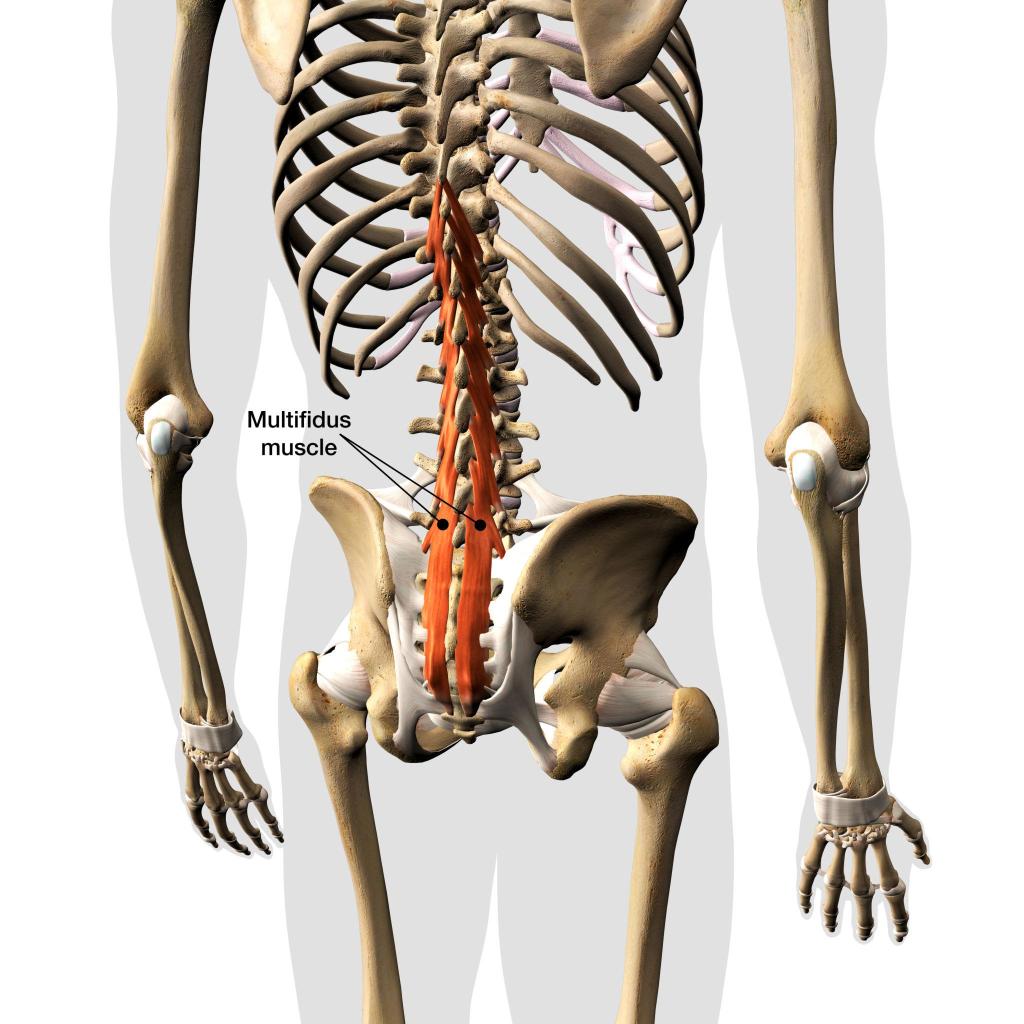
The multifidus tends to be discussed, if at all, as an anatomic detail rather than a functional system. It is a small, deep muscle responsible for segmental control and resistance to shear at individual lumbar levels. Its role is not to generate force but to provide stability during routine movement. When it degenerates, most commonly seen as fatty infiltration on MRI, functional muscle tissue is replaced by fat. This change reflects reduced stabilizing capacity and can result from chronic disuse, denervation, aging, or prior injury. These features are usually present on preoperative imaging but are rarely incorporated into formal decision-making.¹
Over the past several years, evidence has accumulated linking multifidus degeneration to poorer surgical outcomes. Higher degrees of fatty infiltration have been associated with worse postoperative pain, smaller improvements in disability, and increased mechanical complications following lumbar surgery.¹,³ Importantly, these associations persist even after accounting for disc degeneration and alignment, suggesting that muscle quality is not simply a secondary marker of spinal disease but an independent contributor to outcome.
This pattern was clearly illustrated in a 2024 retrospective cohort study published in Global Spine Journal. Burkhard and colleagues reviewed 216 patients who underwent open posterior lumbar fusion between 2014 and 2022 with a minimum of two years of follow-up. Preoperative MRIs were evaluated for a broad range of factors, including disc degeneration, Modic changes, spinopelvic alignment, and paraspinal muscle characteristics. Patients who later developed adjacent segment disease requiring revision surgery showed significantly greater preoperative multifidus fatty infiltration than those who did not require additional surgery.²
When the authors adjusted for age and sex in multivariable regression analysis, multifidus fatty infiltration was the only imaging variable independently associated with revision surgery for adjacent segment disease. Disc degeneration severity and sagittal alignment, which are often emphasized in surgical planning, did not demonstrate comparable predictive value. Receiver operating characteristic analysis suggested a threshold of roughly 58 percent fatty infiltration, above which the risk of revision surgery increased by an estimated 2.7 times.²
Similar observations have been reported in studies focused on instrumentation failure. In a recent European Spine Journal publication, fatty infiltration of the multifidus was associated with higher rates of pedicle screw loosening after short segment lumbar fusion, particularly at levels adjacent to the fusion construct.³ These findings support the idea that compromised muscular stabilization may contribute to abnormal load transfer and accelerated degeneration at neighboring segments.
Beyond mechanical outcomes, multifidus degeneration has also been linked to persistent postoperative pain and limited functional recovery. Reviews examining lumbar spine surgery outcomes consistently show that patients with greater preoperative paraspinal muscle fatty infiltration experience less improvement in disability and quality of life measures, even when radiographic objectives are achieved.¹,⁴ From an observer’s perspective, this disconnect helps explain why technically successful operations sometimes produce disappointing clinical results.
The biomechanical rationale is straightforward. Lumbar fusion alters load distribution and increases stress on adjacent segments. When the multifidus is already compromised, its ability to moderate these forces is diminished. The result may be earlier adjacent segment degeneration, greater strain on instrumentation, and a higher likelihood of revision surgery.²,³ Despite this, muscle quality remains largely absent from standard risk discussions.
Taken together, these data suggest that multifidus muscle quality deserves more attention than it typically receives in preoperative evaluation. For an observer of current surgical practice, the notable point is not that muscle degeneration matters, but that it is so often visible and so often ignored. Incorporating routine assessment of multifidus fatty infiltration into preoperative MRI review could improve risk stratification, patient counseling, and operative planning. Whether interventions aimed at improving muscle quality can meaningfully alter outcomes remains uncertain and will require prospective study.²
At present, multifidus fatty infiltration appears to be more than an incidental imaging finding. It is a measurable factor associated with long term outcomes after lumbar spine surgery, including the risk of repeat intervention. As surgical techniques continue to evolve, broader attention to the muscular system may help explain outcome variability that structural imaging alone has failed to account for.
References
- Sun K, et al. Association between multifidus fatty infiltration and outcomes after lumbar spine surgery. J Orthop Surg Res. 2023;18:XXX–XXX.
- Burkhard MD, et al. Multifidus degeneration: the key imaging predictor of adjacent segment disease following lumbar fusion. Global Spine J. 2024;14(6):21925682241300085. doi:10.1177/21925682241300085
- Ekşi MŞ, et al. Fatty infiltration of the multifidus muscle predicts pedicle screw loosening following short segment lumbar fusion. Eur Spine J. 2025;34:XXX–XXX.
- Ranger TA, et al. Paraspinal muscle morphology and its relationship to pain and disability following lumbar spine surgery. Spine J. 2022;22(4):XXX–XXX.
 The Brit Factor
Leave a comment