
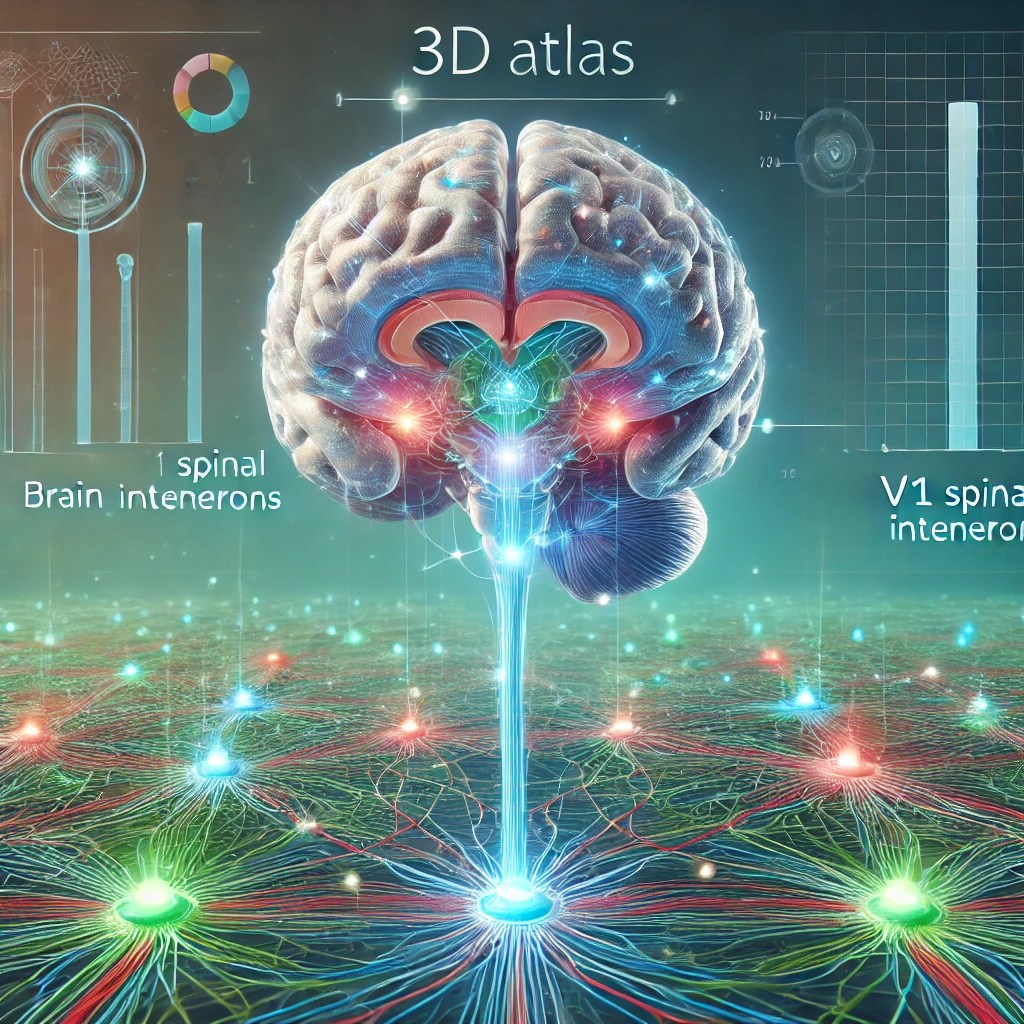
Researchers at St. Jude Children’s Research Hospital have developed a comprehensive 3D atlas that maps the connections between brain regions and V1 spinal interneurons—key “switchboard” cells that modulate motor output. Utilizing a genetically modified rabies virus, they precisely traced neural pathways from the brain to these diverse interneurons in the spinal cord. This innovative atlas enhances our understanding of how brain signals regulate movement and offers a valuable tool for future studies on motor control and related disorders.[1]
What does the study say?[2]
This study presents a comprehensive brain-wide atlas mapping the descending inputs to spinal V1 interneurons, a major inhibitory neuronal class involved in motor control. Using advanced techniques like rabies-virus-based retrograde tracing and serial two-photon tomography, researchers identified 26 distinct brain regions providing direct monosynaptic (a type of neural connection in which a signal travels directly from one neuron to another across a single synapse) inputs to cervical V1 interneurons (a specific class of inhibitory interneurons located in the cervical region of the spinal cord. They play a critical role in motor control by modulating neural circuits that coordinate movement, particularly in the forelimbs). These regions include cortical (the network of regions within the cerebral cortex, the outer layer of the brain responsible for higher-order functions, including sensory perception, motor control, language, memory, and decision-making), midbrain (also known as the mesencephalon, is a central part of the brainstem that plays a pivotal role in sensory processing, motor control, and various autonomic and reflexive functions. It acts as a bridge connecting higher brain regions–like the cerebral cortex–with lower brainstem and spinal cord structures) , cerebellar (centered on the cerebellum, is a vital neural structure responsible for coordinating voluntary movements, maintaining balance, posture, and fine-tuning motor activities. It works in conjunction with other parts of the brain and spinal cord to ensure smooth, precise, and adaptive movements.), and neuromodulatory (refers to networks of neurons and their associated neurotransmitters that regulate the activity of other neurons, rather than directly transmitting signals. This system plays a critical role in modulating brain function, influencing processes such as arousal, attention, learning, memory, mood, and motor control) systems, with significant inputs from the medullary (or the medulla oblongata, is a vital part of the brainstem located just above the spinal cord and below the pons. It plays a crucial role in autonomic functions and connects the brain to the spinal cord, serving as a conduit for sensory and motor signals) and pontine (or the pons, is a central part of the brainstem located between the medulla oblongata and the midbrain. The pons serves as a critical relay center, connecting various parts of the brain, including the cerebrum, cerebellum, and spinal cord. It plays an essential role in motor control, sensory processing, and autonomic functions, as well as sleep and arousal) areas of the hindbrain.
Two subsets of V1 interneurons, V1Foxp2 and V1Pou6f2, were found to receive inputs from overlapping but biased sources. V1Foxp2 interneurons showed enriched inputs from vestibulospinal systems, while V1Pou6f2 interneurons exhibited preferential input from the gigantocellular reticular nucleus (GRN).
Clinical Relevance
- Motor Disorder Insights:
- This mapping elucidates the neural pathways controlling movement, potentially offering insights into conditions such as spinal cord injuries, stroke, and Parkinson’s disease.
- Understanding biased connectivity patterns could help identify specific pathway dysfunctions linked to motor control deficits.
- Therapeutic Targets:
- The identification of molecularly distinct V1 interneurons and their preferential supraspinal inputs provides targets for therapies aimed at restoring motor function.
- Neuromodulation techniques, like deep brain stimulation or optogenetics, could benefit from this detailed connectivity map.
- Rehabilitation Strategies:
- Tailoring rehabilitation approaches to leverage specific pathways (e.g., targeting vestibulospinal inputs for balance recovery) could enhance outcomes for patients with impaired motor coordination.
References
[1] Bryant, C. (2024, December 23). Mapping Brain-to-Spinal Cord Pathways for Motor Control. NeuroscienceNews.Com. https://neurosciencenews.com/brain-mapping-spine-brain-motor-28285/
[2] A brain-wide map of descending inputs onto spinal V1 interneurons. (2025). In Neuron (Vols. 113–1, pp. 1–15). https://doi.org/10.1016/j.neuron.2024.11.019
 The Brit Factor
Leave a comment