
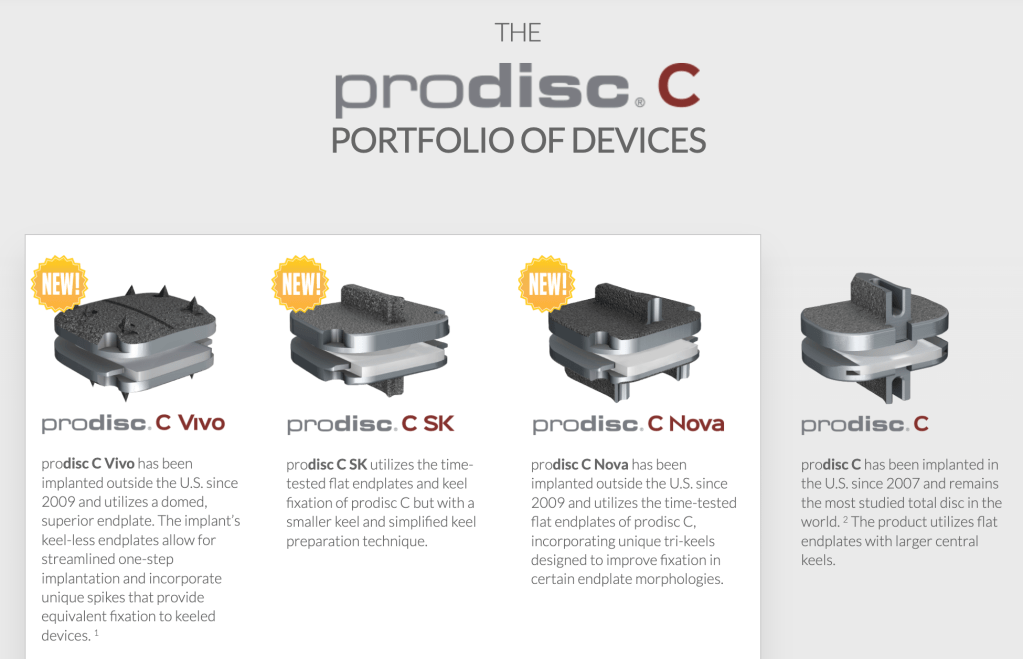
Centinel Spine has announced the first U.S. implantation of its prodisc® C Nova cervical total disc replacement (TDR) device, marking the company’s fourth cervical TDR offering. This follows the U.S. Food and Drug Administration’s approval of prodisc C Nova for single-level indications in July 2022. The prodisc C Nova features a unique tri-keel design and flat endplates, allowing surgeons to address individual patient anatomy effectively. This addition enhances Centinel Spine’s portfolio, providing surgeons with a comprehensive range of cervical TDR solutions to match patient-specific needs.[1]
Way earlier…
In 1966, Ulf Fernström introduced the first artificial cervical device, a stainless steel ball bearing prosthesis, which was used in both lumbar and cervical spinal regions (191 lumbar and 13 cervical implants). Concurrently, a South African team experimented with similar devices. The primary uses were for headaches and cervicobrachialgia, but clinical follow-ups revealed high failure rates due to subsidence, migration, and adjacent-segment hypermobility. These issues led to a decline in interest in cervical arthroplasty, shifting preference toward Smith and Robinson’s arthrodesis techniques.[2] (Smith and Robinson’s arthrodesis techniques, developed in the 1950s, revolutionized cervical spine surgery by introducing anterior cervical discectomy and fusion (ACDF).[3] BUT that’s not the focus of today’s post.)
The Cummins-Bristol Disc, developed in 1989 by B.H. Cummins at Frenchay Hospital in Bristol, UK, was an early cervical arthroplasty prototype inspired by the success of lumbar devices in Europe. This 2-piece, metal-on-metal stainless steel device featured a ball-and-socket articulating surface and anterior anchoring screws to secure it to adjacent vertebrae. However, clinical results in an initial cohort of 18 patients were disappointing, with complications including screw pullout (3 cases), screw breakage (1 case), subluxation (1 case), and persistent dysphagia reported in all patients. These challenges highlighted significant limitations in the device’s design and implementation.[2]
The Prestige Disc evolved from the redesign of the Cummins-Bristol device into the Frenchay cervical disc, addressing earlier issues with hardware failure and high-profile design. Initial studies in 2002 showed improved outcomes, leading to further research, and the device was later acquired by Medtronic and renamed the Prestige Disc. A pivotal 2007 U.S. randomized clinical trial demonstrated that the device maintained segmental motion, improved clinical outcomes, and reduced secondary surgery rates compared to ACDF. Approved by the FDA in July 2007 for treating intractable radiculopathy or myelopathy at C3–C7 levels, the Prestige ST featured a stainless steel, metal-on-metal design. Its successor, the Prestige LP, incorporates a titanium-ceramic composite for MR compatibility and a porous titanium coating to promote bone in-growth, and is currently under FDA IDE evaluation.[2]
The Bryan cervical disc, designed in the 1990s by American neurosurgeon Vincent Bryan, is an unconstrained device consisting of two titanium alloy shells and a polyurethane core. Unlike other devices, it relies on a tight fit within a milled concavity for stability, with bone ingrowth bonding it to the vertebrae over time. Early European multicenter trials demonstrated high clinical success rates of 86% at six months and 90% at one year, with no hardware failures and minimal complications, including one non-revision case of device migration. U.S. IDE trials further confirmed its efficacy, showing greater improvement in outcomes at 24 months compared to single-level ACDF, a lower rate of serious adverse events (1.7% vs. 3.2% in ACDF), and faster return to work by nearly two weeks. These findings highlight the Bryan disc’s effectiveness in preserving motion and reducing recovery times, positioning it as a significant advancement in cervical disc arthroplasty.[2]
The ProDisc-C device, developed by Dr. Thierry Marnay of France and based on the ProDisc-L for lumbar arthroplasty, is a semiconstrained cervical prosthesis composed of cobalt-chromium-molybdenum (CCM) end plates with a UHMWPE articulating surface. Its design includes keels on the external surfaces to anchor the device securely into the vertebral end plates. Results from the FDA IDE trial showed significant reductions in neck and arm pain intensity and frequency (p < 0.0001) compared to preoperative levels, with comparable outcomes to ACDF in terms of neurological success at 24 months (90.9% for ProDisc-C vs. 88% for ACDF; p = 0.638). However, ProDisc-C demonstrated a lower rate of secondary surgeries (1.8% vs. 8.5%; p = 0.033). The study concluded that ProDisc-C is a safe and effective treatment for single-level cervical radiculopathy, offering clinical outcomes equivalent or superior to ACDF. The device was approved by the FDA in December 2007, marking it as a key advancement in motion-preserving cervical spine treatments.[2]
The PCM device, developed by orthopedic spine surgeon Paul McAfee, is a 2-piece cervical disc prosthesis featuring a cobalt-chromium-molybdenum (CCM) end plate with a UHMWPE inner core. Its design emphasizes a broad radius of curvature for enhanced lateral end-plate support, along with a titanium calcium phosphate coating to improve anchorage. Initial pilot studies involving 82 implants in 53 patients demonstrated significant clinical improvements, with only one case of non-revision device migration. The device is undergoing an FDA IDE trial and was acquired by NuVasive in 2009, signaling its potential impact on cervical arthroplasty.[2]
The CerviCore device, developed by Stryker Spine, is a semiconstrained, metal-on-metal prosthesis with a saddle-shaped articulating surface and spiked keels for anchorage. Its unique design aims to replicate natural cervical spine kinematics during different movements. Preliminary testing shows its ability to preserve range of motion, and it is currently under evaluation in an FDA IDE trial, positioning it as a promising option for motion-preserving cervical treatments.[2]
prodisc-C
A pivotal U.S. Investigational Device Exemption (IDE) trial was conducted to evaluate ProDisc-C’s safety and efficacy compared to anterior cervical discectomy and fusion (ACDF). Results revealed similar demographics between groups (ProDisc-C: 42.1 ± 8.4 years, 44.7% males; Fusion: 43.5 ± 7.1 years, 46.2% males), with C5-C6 being the most commonly treated level (ProDisc-C: 56.3%; Fusion: 57.5%). Both groups showed significant improvements in NDI, SF-36, and VAS scores for neck and arm pain at all follow-ups compared to pre-surgery levels (p < 0.0001), with no differences between treatments. At 24 months, 90.9% of ProDisc-C and 88.0% of Fusion patients achieved neurological success (p = 0.638), and 84.4% of ProDisc-C patients maintained or improved motion at the treated level. Secondary surgeries were significantly less frequent in ProDisc-C patients (1.8% vs. 8.5%; p = 0.033), and 89.9% of ProDisc-C patients were not using strong narcotics or muscle relaxants compared to 81.5% of Fusion patients. These findings highlight ProDisc-C’s advantages in motion preservation and reduced secondary interventions.[4]
In December 2007, ProDisc-C received FDA approval to treat single-level degenerative disc disease in the cervical spine. It was the second cervical disc prosthesis approved in the U.S., following the Prestige Disc.[5]
On July 13, 2022, Centinel Spine announced that the U.S. Food and Drug Administration (FDA) granted Pre-Market Application (PMA) approval for three additional cervical total disc replacement (TDR) devices: prodisc C Vivo, prodisc C Nova, and prodisc C SK. These devices, alongside the existing prodisc C implant, expand Centinel Spine’s portfolio, offering surgeons a broader range of options to match individual patient anatomies. The prodisc C Vivo and prodisc C Nova have been utilized internationally since 2009, with prodisc C Vivo being the most frequently implanted TDR outside the U.S.[6]
The ProDisc-C Nova incorporates a trapezoidal footprint to better match patient anatomy and reduce the need for intraoperative remodeling. The first U.S. implantation occurred in October 2024, marking a significant advancement in cervical TDR options available to surgeons.[7]
References
[1] Llc, C. S. (2024, October 31). Centinel Spine® Extends Leadership in Total Disc Replacement through First U.S. Use of prodisc® C Nova, the Fourth prodisc Cervical Design. PR Newswire. https://www.prnewswire.com/news-releases/centinel-spine-extends-leadership-in-total-disc-replacement-through-first-us-use-of-prodisc-c-nova-the-fourth-prodisc-cervical-design-302291834.html
[2] Baaj, A. A., Uribe, J. S., Vale, F. L., Preul, M. C., & Crawford, N. R. (2009). History of cervical disc arthroplasty. Neurosurgical FOCUS, 27(3), E10. https://doi.org/10.3171/2009.6.focus09128
[3] SMITH, G. W., & ROBINSON, R. A. (1958). The treatment of certain cervical-spine disorders by anterior removal of the intervertebral disc and interbody fusion. The Journal of bone and joint surgery. American volume, 40-A(3), 607–624. https://journals.lww.com/jbjsjournal/citation/1958/40030/the_treatment_of_certain_cervical_spine_disorders.9.aspx
[4] Murrey, D., Janssen, M., Delamarter, R., Goldstein, J., Zigler, J., Tay, B., & Darden, B. (2009). Results of the prospective, randomized, controlled multicenter Food and Drug Administration investigational device exemption study of the ProDisc-C total disc replacement versus anterior discectomy and fusion for the treatment of 1-level symptomatic cervical disc disease. The spine journal : official journal of the North American Spine Society, 9(4), 275–286. https://doi.org/10.1016/j.spinee.2008.05.006
[5] Public Health Service, DEPARTMENT OF HEALTH & HUMAN SERVICES, & Food and Drug Administration. (2007). Letter from Food and Drug Administration to Synthes Spine, Inc. regarding ProDiscTM-C Total Disc Replacement. In Letter. https://www.accessdata.fda.gov/cdrh_docs/pdf7/P070001A.pdf
[6] Llc, C. S. (2022, July 13). Centinel Spine® Receives FDA Approval for 3 Additional prodisc® Cervical Total Disc Replacement Devices. PR Newswire. https://www.prnewswire.com/news-releases/centinel-spine-receives-fda-approval-for-3-additional-prodisc-cervical-total-disc-replacement-devices-301585820.html?utm_source=chatgpt.com
[7] Llc, C. S. (2024, October 31). Centinel Spine® Extends Leadership in Total Disc Replacement through First U.S. Use of prodisc® C Nova, the Fourth prodisc Cervical Design. PRNewswire. https://www.prnewswire.com/news-releases/centinel-spine-extends-leadership-in-total-disc-replacement-through-first-us-use-of-prodisc-c-nova-the-fourth-prodisc-cervical-design-302291834.html?utm_source=chatgpt.com
 The Brit Factor
Leave a comment