
Since the release of ChatGPT on November 30, 2022, there has been a lot of controversy around the utilization of AI when it comes to the professional landscape. What began as a productivity tool for writing essays and coding with short prompts has grown into a powerhouse used by over 92% of Fortune 500 companies.[1]
ChatGPT is based on OpenAI’s advanced GPT models, fine-tuned for conversation using supervised and reinforcement learning. Each response considers prior prompts for context. Originally released as a free research preview, ChatGPT now operates on a freemium model, where free-tier users access GPT-4-turbo. Subscriptions like “Plus,” “Team,” and “Enterprise” offer added features, including DALL-E 3 image generation and higher usage limits.[2]
I follow a few Marketing accounts that have been promoting a symbiotic way you can use AI for your daily tasks (work smarter, not harder) and what I was able to gather, a few practical ways that ChatGPT can help include crafting headlines, generating lists of potential keywords around a specific topic, write scripts for customer support, create questions for customer surveys, and overall, use as a virtual brainstorming partner to spark new ideas or perspectives (which is a personal huge benefit).
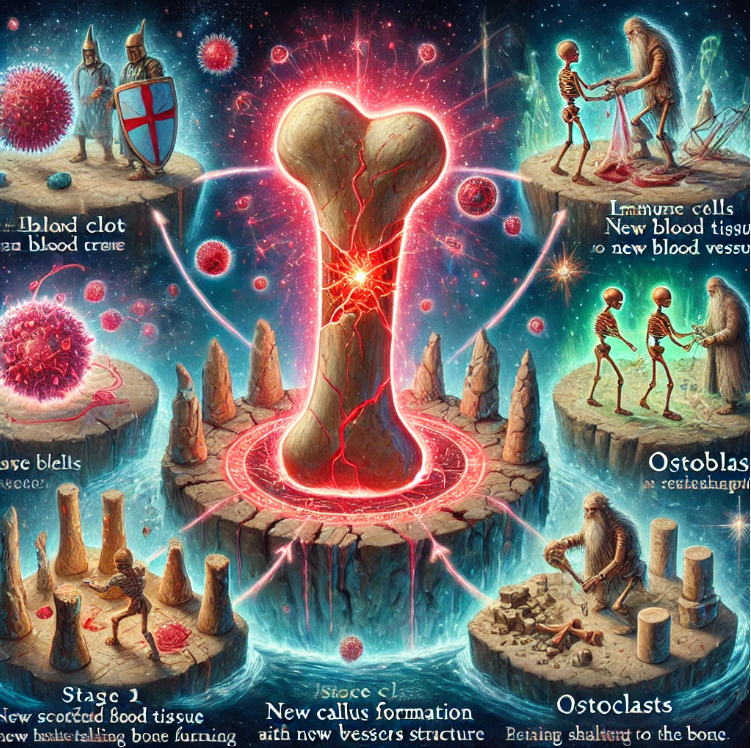
I’ve been doing a lot of research into the processes that occur when a bone is injured and the steps the body takes to heal. Just for fun, I asked ChatGPT to write my data as a story. It made me laugh, so I wanted to share the fantastical story telling that is ChatGPT.
Once upon a time,
in a land not so different from ours, there was a mighty warrior named Bone. Strong and resilient, Bone defended the body from countless challenges. But one day, in the heat of battle, Bone suffered a grave injury—a crack that split it in two. The body, an ancient healer, knew exactly what to do and set in motion a magical process to mend Bone back to strength.
The first phase began as the sun dipped below the horizon. The land surrounding Bone’s fracture grew dark, and a thick, protective blood clot, like a crimson blanket, wrapped itself around the wound. This was the Inflammation Phase, an immediate response that called for help from the mighty warriors of the body—the immune cells. Swift and fierce, macrophages and neutrophils arrived at the site, clearing out the fallen, dead cells and releasing signals that echoed through the body. Their call reached far and wide, summoning the powerful healers, mesenchymal stem cells, to aid in Bone’s recovery.
As days passed, Bone entered the second stage: the Soft Callus Formation. Under the moonlit sky, a new scaffold began to form around the fracture—a soft, cushiony callus that held Bone steady as it began to mend. Mesenchymal stem cells, alongside fibroblasts, wove together a delicate tapestry of granulation tissue. Some transformed into chondrocytes, which conjured cartilage to fill the gap between the broken pieces. Slowly, the callus connected Bone’s broken ends, giving it a chance to heal, though the structure was still fragile. Blood vessels, like tiny rivers, grew back into the wounded area, restoring life to the healing Bone.
As the weeks turned to months, Bone grew stronger. The callus became more rigid, and the Hard Callus Formation began. In the heart of the fracture, a grand transformation was taking place. Bone’s two allies, intramembranous and endochondral ossification, each took up their task. In areas rich with new blood vessels, osteoblasts—Bone’s builders—began laying down new layers directly. Meanwhile, in the less-vascularized areas, cartilage turned to bone in a slow, steady process. The once-soft callus hardened, transforming into woven bone. Though rough and not yet as mighty as before, Bone was no longer fragile.
Finally, as seasons changed, the last and longest phase arrived: Bone Remodeling. This was the moment when Bone would reclaim its former strength and structure. Osteoclasts, masters of reshaping, chipped away at the rough woven bone, while osteoblasts meticulously laid down lamellar bone in its place. The new bone, arranged in a graceful and organized pattern, grew resilient against the pressures and stresses Bone had once endured with ease. Slowly, the shape and strength returned, as the bone remodeled to its original form, ready once more to serve and protect.
And so, over months, even years, Bone stood strong again—a testament to the body’s miraculous power of healing, resilience, and rebirth.
References
[1] Wiggers, K., Corrall, C., & Stringer, A. (2024, November 1). ChatGPT: Everything you need to know about the AI-powered chatbot. TechCrunch. https://techcrunch.com/2024/11/01/chatgpt-everything-to-know-about-the-ai-chatbot/#:~:text=ChatGPT%2C%20OpenAI’s%20text%2Dgenerating%20AI,its%20launch%20in%20November%202022.
[2] Wikipedia contributors. (2024, November 5). ChatGPT. Wikipedia. https://en.wikipedia.org/wiki/ChatGPT
Image also generated by ChatGPT
 The Brit Factor
Leave a comment