
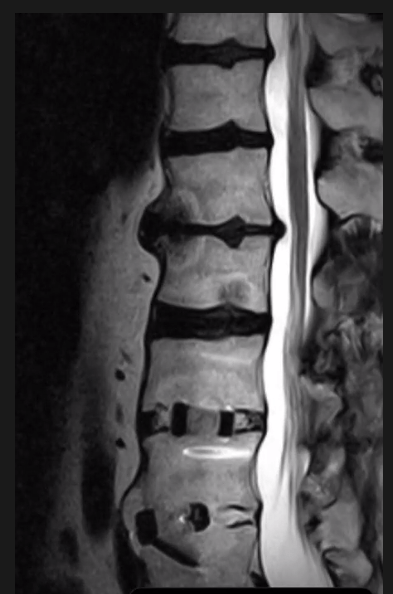
“Schmorl’s nodes are herniations of nucleus pulposus through the cartilaginous and bony endplate into the adjacent vertebra…In postmortem studies, it has been estimated that greater than 70% of the population has Schmorl’s nodes.”[1,2]
So if there IS such a prevalence of this condition, why have I been in this industry for 14 years AND JUST NOW hearing this?
(Not to mention that now I have a desire to go watch “The Sandlot” because my brain has connected “schmorl” with “s’mores”…)

Pathologist Christian Georg Schmorl first coined the term in 1927 when he noticed a specific type of vertebral lesion (any area of abnormal tissue on the spinal cord) primarily in the thoracolumbar spine (the transitional zone between the stiff thoracic cage and the mobile lumbar spine) that did not follow a horizontal path (like disc herniations into the spinal canal).
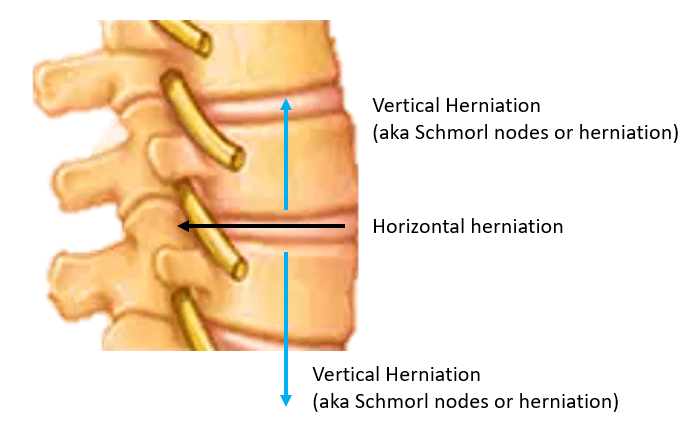
The cause of Schmorl Nodes (SN) is unknown, but likely involves a combination of factors. Demographically, SNs are more common in males and some studies have suggested higher prevalence with age.[3] (As you age, your body degenerates. For your vertebral body endplates, this means the surface weakens, which can increase the risk of the intervertebral body pushing through.) Most cases are asymptomatic and resolve on their own or with conservative treatment, while others lead to chronic pain. Unlike horizontal herniations which press on the spinal canal and cause radiating pain, SNs are thought to cause pain through inflammation caused by the herniation pressing again the bone marrow.[4]
Multiple SNs are significantly associated with lumbar disc disease.[2] In the case that painful SNs cannot be treated conservatively with pain relievers, rest, and back bracing, surgical treatment with lumbar interbody fusion can help. [3]
Important Note: This post is based on research and should not be considered a substitute for professional medical advice. Always consult a healthcare professional for diagnosis and treatment of any medical condition.
References:
[1] Pietrok, A., Lee, C., Kaye, R. J., Kaye, A. D., & Chesteen, G. (2022). Schmorl’s Node: An Uncommon Case of Back Pain and Radiculopathy. Orthopedic reviews, 14(3), 33641. https://doi.org/10.52965/001c.33641
[2] Kyere, K. A., Than, K. D., Wang, A. C., Rahman, S. U., Valdivia-Valdivia, J. M., La Marca, F., & Park, P. (2012). Schmorl’s nodes. European spine journal : official publication of the European Spine Society, the European Spinal Deformity Society, and the European Section of the Cervical Spine Research Society, 21(11), 2115–2121. https://doi.org/10.1007/s00586-012-2325-9
[3] Hernández, MD, A. (2024). Schmorl’s Node What is it, symptoms, management, and more. Osmosis From Elsevier. https://www.osmosis.org/answers/schmorls-node#:~:text=The%20exact%20cause%20of%20Schmorl’s,protrusion%20of%20the%20intervertebral%20disc.
[4] Medicofit. (2023, February 28). Schmorl’s nodes – everything you need to know. https://medicofit.si/en/schmorls-nodes-everything-you-need-to-know/
 The Brit Factor
Leave a comment